
Key Takeaways
- The best ex-proof fan for workshop use must meet UL Class I Division ratings, not just airflow claims
- Beginners should prioritize portable 120V fans that are easy to position and use safely
- Proper airflow direction matters more than raw power in small garages
- Axial fans work best for open spaces, while blower fans are better for confined areas
- Most users should start with a mid-size axial fan and only upgrade if airflow is insufficient
Explosion-Proof Fans vs Spark Resistant Fans
A spark-resistant fan is designed to reduce the chance of sparks by using materials like aluminum blades or by preventing metal-to-metal contact inside the housing. These fans follow construction guidelines (often based on AMCA standards), but they are not sealed and not rated for hazardous locations. In practice, they are used for moving air that may contain light dust or non-volatile particles, not flammable vapors.
An explosion-proof fan, on the other hand, is built specifically for hazardous environments. It uses a sealed motor housing, non-sparking components, and must meet UL Class I Division ratings. The key difference is containment. Even if a spark occurs inside the motor, it is prevented from igniting the surrounding atmosphere.
Types of Explosion-Proof Fans
Axial Explosion-Proof Fans
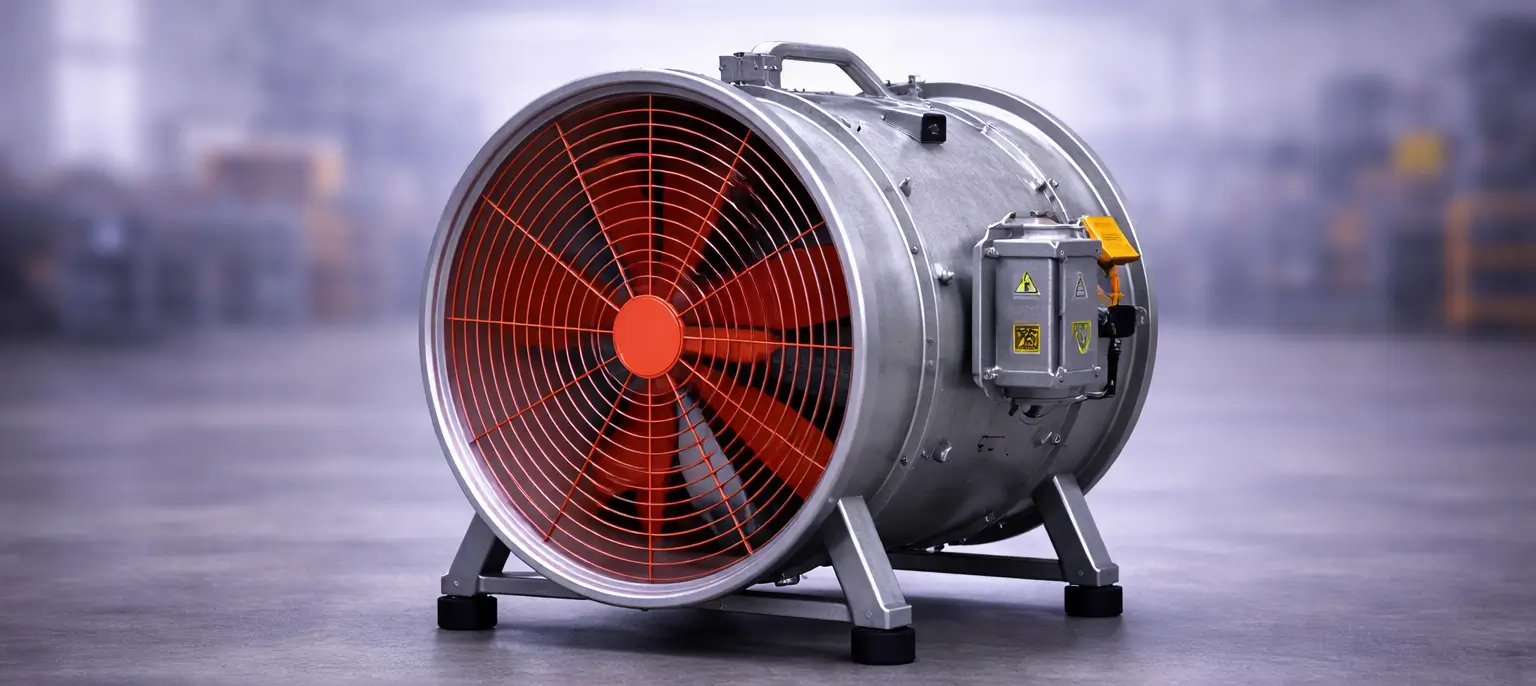
Axial fans move air in a straight path, which makes them well-suited for general ventilation in garages and workshops. They are the most practical option for beginners because they are easy to position and do not require setup beyond plugging in and directing airflow.
In real-world use, axial fans perform best when there is a clear path for air to enter and exit the space. For example, placing one near a garage door or window allows fumes to be pushed out effectively. Their limitation appears when airflow must travel through obstacles or enclosed spaces. In those situations, airflow becomes inconsistent and less effective.
Blower (Centrifugal) Explosion-Proof Fans
Blower fans generate higher pressure airflow, allowing them to push air through ducts or confined areas. This makes them suitable for targeting specific work zones rather than ventilating an entire garage.
In practice, they are most useful when working in enclosed corners or when airflow needs to be directed away from the user. However, they are bulkier and less intuitive for beginners. Many users choose them expecting better performance overall, but in open garages, they often provide less effective coverage than axial fans.
Wall-Mounted Explosion-Proof Fans
Wall-mounted fans are designed for permanent ventilation setups. They are most effective in workshops where airflow is needed consistently, such as frequent painting or solvent use.
They remove the need to reposition equipment and provide steady airflow over time. The limitation is flexibility. Once installed, airflow direction is fixed, which can be restrictive if the workspace layout changes. For beginners, they are only practical when the workflow is stable and repetitive.
Best Ex-Proof Fans for Workshop & Garage Use
TPI Corporation PBS Series Explosion-Proof Fan
This fan focuses on reliability and safety, using a fully enclosed motor and non-sparking components that meet US hazardous location standards. It delivers steady airflow without requiring adjustments, which makes it suitable for consistent workshop use.
Best for: Overall performance and long-term reliability
Key Specs:
- Type: Axial
- Voltage: 115V
- Safety Rating: Class I Division 1 / Division 2
- Build: Aluminum blades
- Motor: Totally enclosed
|
Pros |
Cons |
|
Consistent and stable airflow |
Heavier than portable models |
|
Verified hazardous location rating |
Minimal adjustability |
|
Durable for repeated use |
Higher upfront cost |
Verdict:
A strong overall choice for users who want dependable performance and certified safety without experimenting with different setups.
ACiQ Explosion-Proof Portable Fan
This model is designed around portability and ease of use. It is lightweight and simple to position, which makes it practical for beginners working in smaller garages or changing work areas.
Best for: Beginners and small workspaces
Key Specs:
- Type: Axial
- Voltage: 110–120V
- Safety Rating: UL hazardous location compliant
- Build: Lightweight aluminum housing
- Portability: High
|
Pros |
Cons |
|
Easy to reposition |
Limited airflow range |
|
Straightforward operation |
Not suitable for large garages |
|
Lightweight design |
Less durable than heavier units |
Verdict:
A practical starting point that prioritizes usability. It works well for light to moderate ventilation but is not intended for demanding setups.
Air King 9550 Explosion-Proof Fan
This fan balances airflow and durability, making it suitable for medium-sized workshops. It provides stronger coverage than compact models while remaining manageable for regular use.
Best for: Balanced performance in medium spaces
Key Specs:
- Type: Axial
- Voltage: 120V
- Blade Size: 20-inch
- Safety Rating: Explosion-proof rated motor
- Build: Steel housing
|
Pros |
Cons |
|
Wider airflow coverage |
Noticeable noise level |
|
Solid construction |
Bulkier than smaller fans |
|
Reliable for repeated use |
Less portable |
Verdict:
A well-rounded option for users who need more airflow without moving into complex or fixed systems.
TPI Wall-Mounted Explosion-Proof Fan
This fan is intended for fixed installations where ventilation is needed regularly. It provides continuous airflow without requiring repositioning.
Best for: Permanent workshop setups
Key Specs:
- Type: Wall-mounted
- Voltage: 115V
- Drive: Belt-driven
- Safety Rating: Class I Division rated
- Coverage: Large area
|
Pros |
Cons |
|
Continuous airflow without adjustment |
Requires installation |
|
Covers larger spaces efficiently |
No portability |
|
Built for long-term use |
Less flexible |
Verdict:
Best suited for stable workshop environments where ventilation needs do not change frequently.
Allegro Industries Explosion-Proof Blower Fan
This blower-style fan is designed for controlled airflow in specific areas. It is effective when fumes need to be extracted from confined zones or directed through ducting.
Best for: Targeted airflow and confined spaces
Key Specs:
- Type: Centrifugal blower
- Voltage: 115V
- Safety Rating: UL hazardous location compliant
- Build: Rugged housing
- Portability: Medium
|
Pros |
Cons |
|
High-pressure airflow |
Limited overall coverage |
|
Effective with ducting |
More complex to use |
|
Durable construction |
Less effective in open spaces |
Verdict:
A specialized option that performs well in controlled environments but is not ideal for general garage ventilation.
Best Explosion-Proof Fan – Comparison Table
|
Product |
Key Specs |
Best For |
|
TPI PBS Series |
Axial, 115V, Class I Div rated |
Overall reliability |
|
ACiQ Portable |
Axial, 120V, lightweight |
Beginners |
|
Air King 9550 |
20-inch, 120V |
Balanced use |
|
TPI Wall Mount |
Belt drive, 115V |
Fixed setups |
|
Allegro Blower |
Centrifugal, 115V |
Targeted airflow |
Buying Guide
Understanding Explosion-Proof Ratings
Explosion-proof equipment is classified using Class and Division ratings. Class I refers to environments where flammable gases or vapors may be present. Division 1 means the hazard is present during normal operation, while Division 2 indicates it is present only under certain conditions.
For workshop use, most scenarios fall into Division 2 unless you are constantly working with active vapors. A properly rated fan is designed to contain any internal sparks and prevent them from igniting the surrounding air. Fans without a clearly stated rating should be avoided, even if they are marketed as safe.
Airflow vs Workspace Size
Airflow must match how air moves through your space, not just the fan size. In smaller garages, too much airflow can create turbulence that keeps fumes circulating rather than removing them. In larger spaces, insufficient airflow leads to buildup.
The key is creating a consistent path where air enters from one side and exits from another. Fans only work effectively when this flow is established. Without it, even high-powered models underperform.
Portability vs Fixed Setup
Portable fans allow adjustments based on the task, which is important for beginners who may change their workspace layout frequently. They are easier to position and test until airflow is effective.
Fixed systems provide consistency and reduce setup time, but they limit flexibility. Once installed, they are difficult to adjust. This makes them better suited for workshops with predictable and repeated workflows.
Noise and Real-World Usability
Explosion-proof fans are inherently louder due to sealed motors and metal construction. Noise increases with airflow and size, which can become noticeable during longer sessions.
In practice, smaller fans are easier to tolerate but may require more precise placement. Larger fans provide better coverage but can lead to fatigue if used for extended periods. This trade-off is often overlooked but directly affects usability.
How to Choose (by Use Case)
Beginner Setup (Small Garage)
A portable axial fan is usually sufficient. Positioning is more important than power. Focus on creating a clear airflow path.
Regular Workshop Use
A larger axial fan improves consistency and reduces the need for repositioning. Stability and durability become more important.
Advanced or Enclosed Areas
A blower fan is more effective when airflow must be directed through specific paths. It requires more planning but provides better control.
Common Applications
Painting projects require steady airflow to move fumes out of the workspace. Without proper direction, fumes tend to circulate and linger.
Woodworking involves both dust and vapors. A fan helps with airflow, but does not replace proper dust extraction systems.
Enclosed repair work benefits from controlled airflow, where blower fans can direct fumes away from the user.
General ventilation works best with axial fans when airflow paths are open and unobstructed.
Common Mistakes
Assuming “Explosion-Proof” Means Any Fan Is Safe
Not all fans labeled as safe meet proper hazardous location standards. Without verified ratings, there is still a risk of ignition. Always confirm certification before use.
Choosing Too Much Power
Excessive airflow can disrupt proper ventilation and create turbulence. This reduces effectiveness instead of improving it. Matching airflow to the space is more important than maximizing power.
Ignoring Airflow Direction
A fan alone does not solve ventilation problems. Without a defined path for air to enter and exit, fumes remain in the workspace. Proper placement is essential.
Overlooking Portability
Choosing a fixed solution too early can limit flexibility. Beginners benefit more from portable options that allow adjustments based on different tasks.
Final Words
The best explosion-proof fan for a workshop is not the most powerful one, but the one that matches your space, airflow needs, and safety requirements. For most beginners, a portable axial fan provides the best balance of usability and protection. As the workspace becomes more specialized, more targeted solutions can be introduced.
FAQ
What is an explosion-proof fan?
An explosion-proof fan is designed to prevent ignition of flammable gases or vapors by containing sparks and using non-sparking materials.
What does Class I Division 1 mean?
It indicates the fan is safe for environments where flammable gases are present during normal operation.
Do I need an explosion-proof fan in a garage?
If you work with paint, solvents, or fumes, a properly rated fan reduces the risk of ignition compared to standard fans.
Can I use a regular fan instead?
Regular fans are not designed for hazardous environments and can create ignition risks when fumes are present.
What size fan should I choose?
The correct size depends on your workspace and airflow path. Proper placement is more important than choosing the largest model.