
Why This Matters Today
Every spray gun, air tool, or paint setup you use depends on one thing: air.
Not just air, but controlled, pressurized air.
You turn on a compressor, and everything works. The pressure stays steady. The spray pattern holds. The tool behaves exactly how you expect.
It feels simple.
But it took a long time to get there.
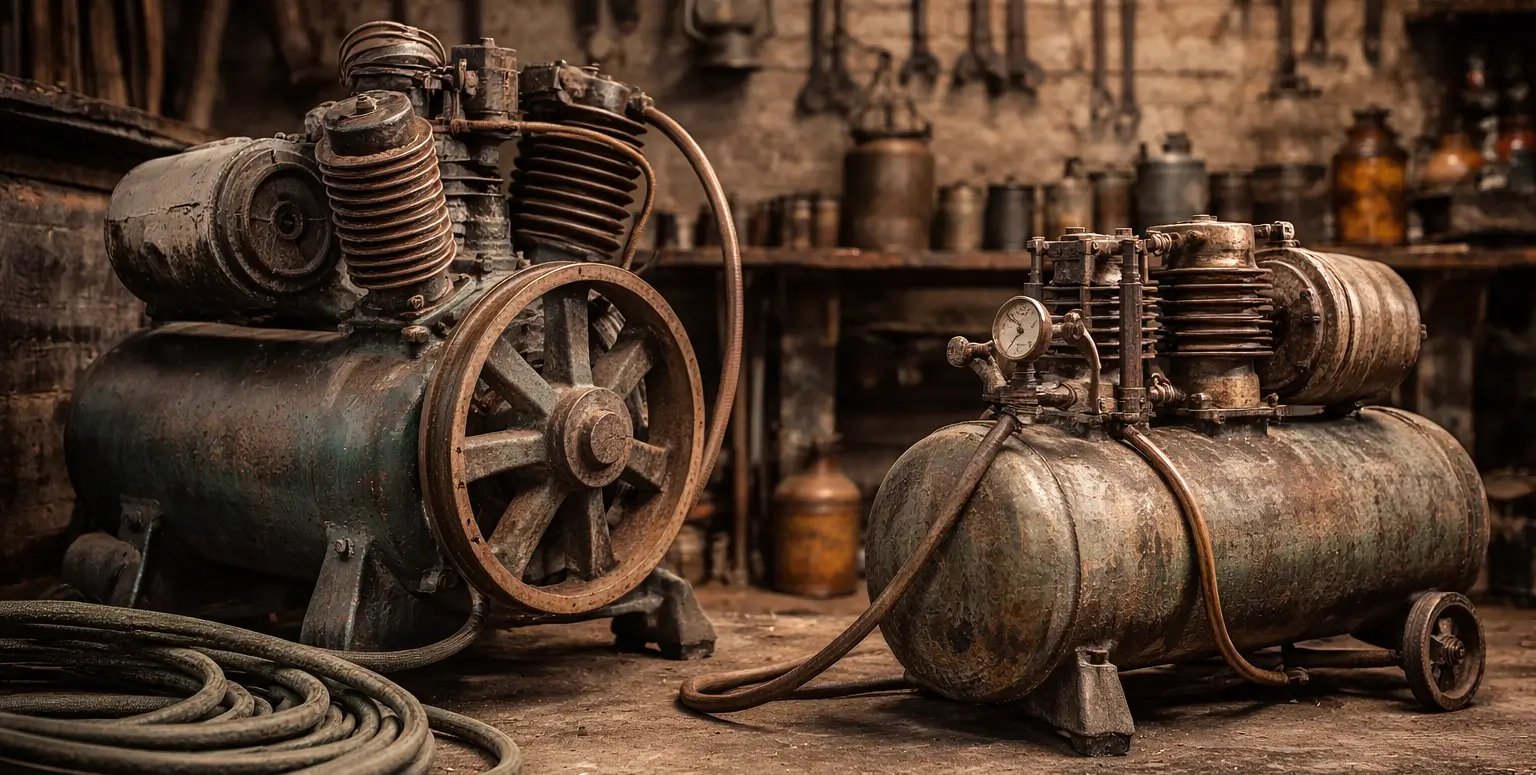
Air compressors didn’t start as machines in workshops. They started as crude tools designed to push air into fire. Over time, they evolved into systems capable of delivering stable, clean, controlled airflow on demand.
Understanding that evolution explains a lot about modern setups. Why airflow matters more than tank size. Why pressure stability affects your finish. Why some systems struggle while others don’t.
Because the problems we deal with today aren’t new. They’re just more refined.
TL;DR
Air compressors evolved from simple manual air-moving tools into precision systems designed to deliver stable, consistent airflow.
The key shifts were straightforward. Early tools focused on producing air. Later systems focused on controlling it. Modern compressors are built around stability, efficiency, and clean air delivery.
What started as a way to feed fire eventually became a way to power tools and control processes.
Before Air Compressors: Moving Air by Hand
Long before compressors existed, people still needed to move air.
Blacksmiths used bellows to feed oxygen into fires. More air meant higher temperatures, which made metal easier to shape.
The system worked, but it had obvious limitations.
It relied entirely on manual effort. Airflow wasn’t consistent. If the person operating the bellows slowed down, the fire lost intensity. That directly affected the work.
The problem wasn’t just effort. It was control.
Keeping a steady flow of air required constant input. There was no storage, no buffering, no stability.
As industries grew, that limitation became harder to ignore.
The First Mechanical Concepts
In the late 1700s, inventors began experimenting with mechanical ways to compress air.
One of the early figures, George Medhurst, explored compressed air systems as a way to store and transport energy. Around the same period, other inventors were working on piston-based mechanisms that could trap and compress air in chambers.
These early machines were far from perfect.
They were inefficient. They leaked air. They generated heat. But they introduced a critical idea that would shape everything that followed.
Air didn’t have to be used immediately.
It could be compressed, stored, and released when needed.
That single shift changed the role of air completely.
The Industrial Revolution: Air Becomes Useful Power
The Industrial Revolution created a demand for energy in many forms.
Steam dominated the era, but compressed air started to find its place in specific environments, especially where safety mattered. In mining, for example, steam engines and combustion systems posed serious risks.
Compressed air offered an alternative.
It could be distributed through pipes, used to power tools, and operated without combustion at the point of use. That made it safer in confined or hazardous spaces.
Early compressors during this time were often powered by steam engines. They used piston systems to compress air into tanks, where it could be stored and used later.
But these systems had clear weaknesses.
They produced heat during compression. They wasted energy. Pressure levels fluctuated. Engineers began focusing on solving those issues, not just building bigger machines.
The Rise of the Piston Compressor
One of the most important developments was the piston, or reciprocating, compressor.
The concept is simple. A piston moves inside a cylinder, compressing air as it travels. It’s a design that still exists today, especially in smaller workshop compressors.
Early versions had limitations. Heat buildup reduced efficiency. Materials wore out quickly. Output wasn’t always stable.
Over time, improvements made a difference.
Multi-stage compression allowed air to be compressed in steps rather than all at once, reducing stress and improving efficiency. Cooling systems were introduced to manage heat. Materials improved, increasing durability.
These changes turned piston compressors into practical, reliable machines.
They became the foundation for compressed air systems in many industries.
Mining and Construction: Where Compressors Became Essential
Air compressors proved their value in mining and large-scale construction.
They powered drills, supported ventilation systems, and made it possible to work in environments where other power sources were less practical.
The advantage wasn’t just power. It was control and distribution.
Compressed air could be sent through pipes over long distances. Multiple tools could run from the same system. That flexibility made compressors a core part of industrial infrastructure.
At this point, compressors were no longer experimental tools. They were essential.
The Electric Shift
The introduction of electric motors changed everything.
Before electricity, compressors depended on large mechanical systems. Steam engines, water power, and complex linkages made them bulky and limited in where they could be used.
Electric motors simplified the design.
Compressors became smaller, easier to operate, and more widely available. Instead of being limited to factories, they started appearing in workshops and smaller environments.
This was the moment when compressors began moving closer to how we use them today.
They became accessible.
Rotary Compressors: Smoother and More Efficient
As demand increased, piston compressors weren’t always the best solution.
They worked well, but they produced pulsating airflow and required more maintenance in continuous-use situations.
This led to the development of rotary designs, particularly rotary screw compressors.
Instead of using a piston, these systems used rotating components to compress air continuously. The result was smoother airflow, less vibration, and better efficiency during long operation periods.
In industrial environments, this made a significant difference.
Continuous airflow meant more stable systems. Less downtime meant higher productivity.
The Hidden Problem: Air Quality
As compressors became more advanced, another issue became impossible to ignore.
Compressed air isn’t clean.
It naturally carries moisture, and depending on the system, it can also contain oil and particles. In early applications, this wasn’t always a concern. But in more precise work, it became a problem.
In spray painting, for example, contaminated air leads to defects. Moisture causes surface issues. Oil creates fisheyes. Particles affect finish quality.
This led to the development of supporting systems.
Air dryers, moisture separators, and filtration systems became part of the setup. Compressors were no longer standalone machines. They were part of a larger system designed to control air quality.
Compressors and Spray Painting
As spray technology improved, compressors had to meet higher expectations.
It wasn’t enough to produce air. The air had to be stable, consistent, and clean.
This is where many modern users run into problems.
A compressor might seem powerful enough, but if airflow drops during a pass, the spray pattern changes. If moisture gets into the line, the finish suffers. If pressure fluctuates, atomization becomes inconsistent.
These issues aren’t new. They’re the same challenges engineers have been working on for decades.
The difference is that today, expectations are higher.
Modern Compressors: Built for Stability
Today’s compressors are designed with control in mind.
You can regulate pressure, manage airflow, and maintain consistency over long periods. Cooling systems reduce heat buildup. Filtration systems improve air quality.
Different designs serve different needs.
Piston compressors are still common in smaller setups. Rotary screw compressors dominate industrial environments. Oil-free compressors are used where clean air is critical.
The focus is no longer just on producing air.
It’s on delivering the right air, consistently.
What Actually Changed
Looking back, the evolution of air compressors comes down to a few key improvements.
Consistency improved. Early systems fluctuated constantly. Modern systems maintain stable pressure.
Efficiency increased. Less energy is wasted, and more usable air is produced.
Control became possible. Pressure, airflow, and quality can now be managed precisely.
Cleanliness became part of the system. Air is filtered, dried, and conditioned before it’s used.
The Real Shift
The biggest change isn’t mechanical.
It’s conceptual.
Early tools were about moving air.
Modern systems are about controlling it.
That includes:
- How much air is delivered
- How stable the pressure is
- How clean the air remains
This shift is what makes modern tools possible.
Final Thoughts
Air compressors didn’t evolve in a straight line.
Each stage solved a different problem.
Early systems focused on producing air. Industrial systems focused on scaling it. Later designs improved efficiency and reliability. Modern systems focus on control and precision.