
Key Takeaways
- Choose DeVilbiss DV1 if you want:
- a forgiving spray gun that maintains consistency even with small mistakes
- stable performance with imperfect air setups
- flexibility across different materials
- Choose Iwata WS400 if you want:
- the finest possible atomization and surface finish
- higher transfer efficiency with less wasted material
- a precise, controlled spraying experience
DV1 prioritizes stability and ease of use, while WS400 prioritizes precision and finish quality.
DeVilbiss DV1 vs Iwata WS400 Spray Guns
These two spray guns compete in the same premium category, but they solve different problems.
The DeVilbiss DV1 is designed to reduce variability during real work. It keeps results consistent even when your technique or setup is not perfect.
The Iwata WS400 focuses on maximum atomization and efficiency. It delivers a finer finish, but only when your air system and technique stay consistent.
This comparison is not about better or worse.
It’s about choosing between:
- DV1 → control and tolerance
- WS400 → precision and refinement
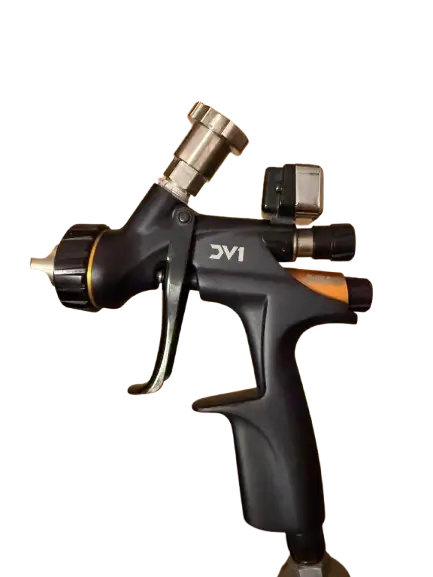
DeVilbiss DV1 – Quick Overview
The DV1 feels stable from the first pass. It smooths out small inconsistencies instead of amplifying them.
How it behaves during spraying
The atomization is controlled rather than aggressive. Droplets are slightly larger than the WS400, but the pattern stays even.
- The fan remains stable across the entire pass
- Material flow does not spike or drop suddenly
- Small variations in distance do not disrupt the pattern
This reduces the chance of uneven coverage or striping.
Strengths in real use
- Maintains consistent output even with minor technique errors
- Handles variations in air pressure without noticeable instability
- Works reliably with different paint types
- Reaches a solid finish quickly without constant correction
The main advantage is predictability. You spend less time fixing mistakes.
Limitations
- Atomization is less refined than the WS400
- Produces more overspray in comparison
- The finish requires more effort to match high-end results
It delivers strong results, but it does not push finish quality to the same level.
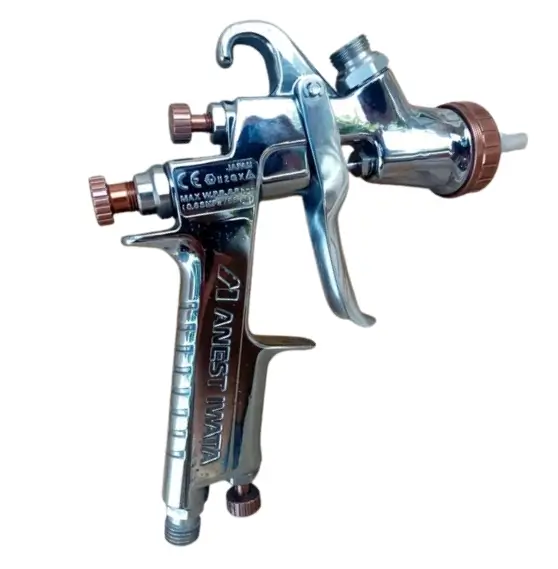
Iwata WS400 – Quick Overview
The WS400 feels more focused and demanding. It reacts directly to every input.
How it behaves during spraying
The atomization is extremely fine. Material breaks down more completely, which creates a smoother surface.
- The fan is dense and tightly controlled
- Output responds immediately to movement changes
- Distance and speed directly affect the finish
This increases precision but removes tolerance.
Strengths in real use
- Produces a noticeably smoother and more refined finish
- Reduces overspray when used correctly
- Transfers more material onto the surface instead of into the air
- Maintains a clean, controlled spray pattern
When everything is stable, the result is clearly superior.
Limitations
- Exposes inconsistencies in technique
- Requires stable air pressure and clean airflow
- Drops in performance if the compressor cannot keep up
- Feels more demanding during long sessions
The gun does not compensate for mistakes. It reveals them.
Comparison Table
Factor | DeVilbiss DV1 | Iwata WS400 |
Atomization | Controlled, slightly coarser | Extremely fine and dense |
Finish Quality | Smooth, but less refined | Lower volume but requires a stable supply |
Forgiveness | High – absorbs small errors | Low – exposes small errors |
Air Consumption | Moderate, tolerant of fluctuation | Lower volume but requires a stable supply |
Overspray | Higher due to broader breakup | Lower when used correctly |
Fan Pattern | Wide and stable | Tight and concentrated |
Transfer Efficiency | Good | Very high |
Compressor Demand | Handles weaker systems | Needs consistent pressure and flow |
Ease of Use | Easier to control | Requires disciplined technique |
Consistency | Stable across varying conditions | Stable only in controlled setups |
Material Versatility | Works across more materials | Optimized for specific setups |
Learning Curve | Shorter | Longer |
Maintenance Sensitivity | Moderate | Higher precision, more sensitive |
How They Feel in Use
This is where the decision becomes clear.
DV1 in real sessions
The DV1 reduces the need for constant correction.
You can adjust speed slightly without affecting coverage, vary distance without breaking the fan pattern, and recover quickly from imperfect passes.
This lowers mental load. Over long sessions, you focus on coverage instead of precision.
It maintains consistency even as fatigue sets in.
WS400 in real sessions
The WS400 requires continuous control.
You must maintain a consistent distance at all times, have a steady hand speed, and monitor the overlap carefully.
If your compressor drops pressure, the pattern changes immediately. The finish quality drops with it.
The result is higher precision but also higher effort.
Technical Details – DeVilbiss DV1
- Air consumption: ~270–300 L/min (varies by air cap)
- Operating pressure: ~1.5–2.0 bar
- Nozzle sizes: 1.2 / 1.3 / 1.4
- Weight: ~445 g
- Cup capacity: 560 ml (DV1 system)
- Air caps: C1, C2 variants
- Compatible materials: basecoat, clearcoat
Technical Details – Iwata WS400
- Air consumption: ~230–260 L/min
- Operating pressure: ~1.8 bar
- Nozzle sizes: 1.2 / 1.3 / 1.4
- Weight: ~380 g
- Cup capacity: 600 ml
- Technology: split nozzle design
- Focus: high transfer efficiency applications
Choosing Between Them
Your decision depends on how controlled your setup is and how much precision you can maintain.
Get the DeVilbiss DV1 when you:
- have a compressor setup that fluctuates under load
- want consistent results without constant adjustment
- switch between different materials or tasks
- prioritize control and stability over maximum refinement
Choose the Iwata WS400 when you:
- have an air system that delivers stable pressure and clean airflow
- aim for the highest possible finish quality
- can maintain consistent technique over long sessions
- work in controlled, repeatable conditions
If you want to learn more about the comparison of the brands, see the Iwata vs DeVilbiss guide.
Final Thoughts
The difference comes down to how each gun handles imperfection.
- The DeVilbiss DV1 minimizes the impact of inconsistencies
- The Iwata WS400 converts precision into higher-quality results
If your workflow includes variation, the DV1 keeps results stable.
If your workflow is controlled and repeatable, the WS400 delivers a higher ceiling in finish quality.
FAQ
Is the WS400 suitable for beginners?
No. It requires stable technique and setup. Beginners struggle to maintain consistent results.
Does the DV1 use more paint?
Yes, due to higher overspray. The difference becomes noticeable in larger jobs.
Which is better for clear coat?
WS400. It produces a smoother, more refined surface with less texture.
Can DV1 deliver professional-level results?
Yes. It produces consistent, high-quality finishes, but not at the same refinement level as the WS400.
Does compressor quality affect the WS400 more?
Yes. Any drop in pressure or airflow directly affects atomization and finish quality.