
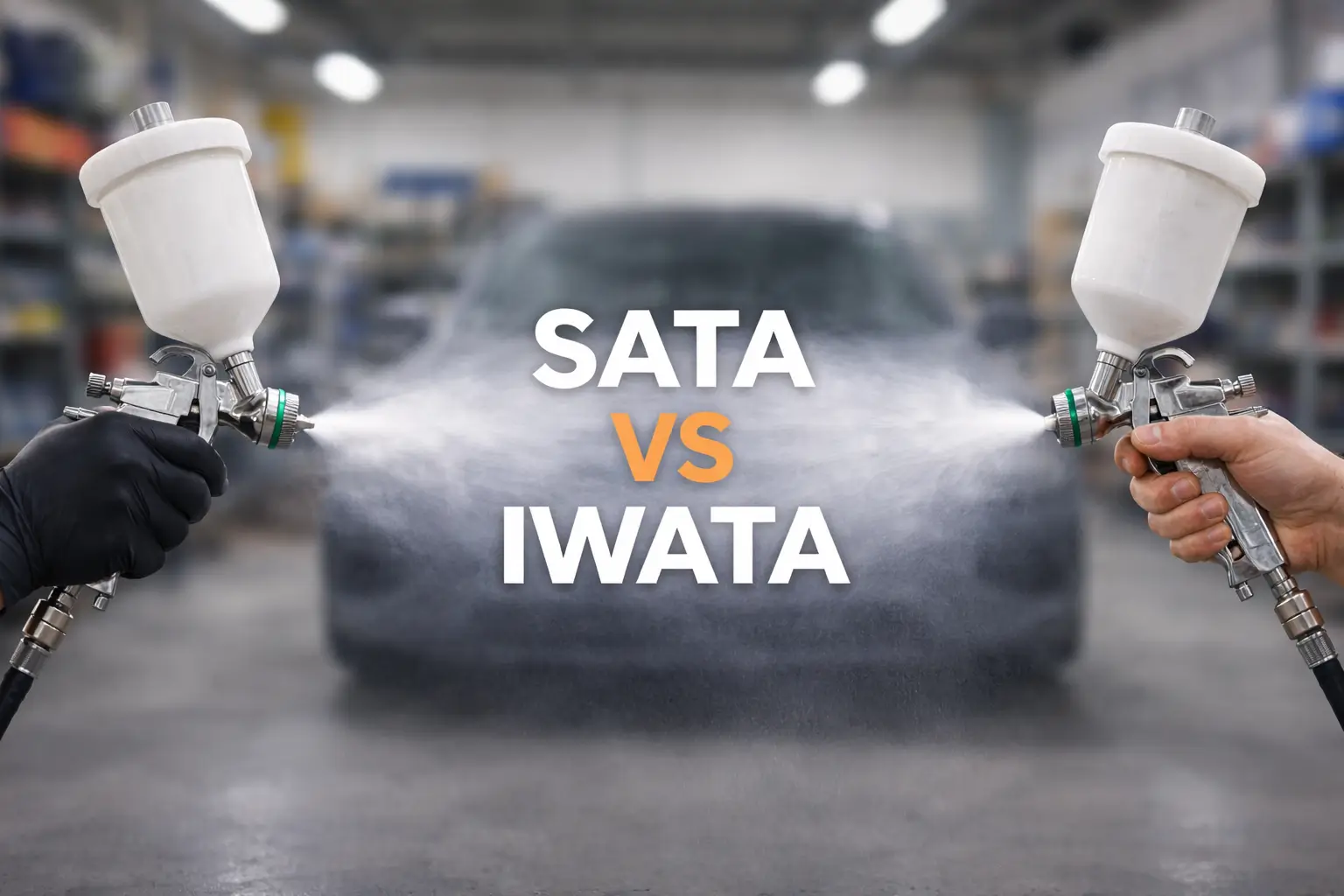
Key Takeaways:
If you want a clear answer without overthinking it:
- Choose SATA if you want speed, strong coverage, and a gun that stays consistent across long jobs.
- Choose Iwata if you care about control, finer atomization, and achieving the smoothest possible finish.
The core difference:
- SATA pushes material with confidence
- Iwata gives you more control over how that material lays
For most people:
- Faster workflow, larger panels → SATA
- Detail, control, finish refinement → Iwata
What You’re Actually Comparing
At a surface level, SATA and Iwata sit in the same category. Both are premium brands. Both are used in professional environments. Both can produce excellent results.
But once you actually spray with them, the difference is obvious.
SATA is built around output and consistency. The gun delivers a strong, even spray that doesn’t change much from pass to pass.
Iwata is built around control and atomization. The spray is more refined, and you can influence how the paint lays with more precision.
This isn’t a small difference in specs. It’s a difference in how the gun behaves in your hand.
Where the Differences Actually Matter
Atomization and Finish Quality
Iwata has built its reputation on atomization.
The droplets are typically finer, which helps paint lay flatter, especially in clear coat. That’s why many painters describe Iwata as producing a “glass-like” finish when everything is dialed in.
SATA atomizes differently.
It still produces a high-quality finish, but the delivery is more aggressive. It pushes more material through the air, which can result in slightly more texture if not controlled properly.
In real use:
- Iwata gives you a smoother starting point
- SATA gives you strong, even coverage
Spray Pattern and Coverage
This is one of the clearest differences.
SATA guns are known for wide, even spray patterns. You can cover large surfaces with fewer passes, which makes them efficient for full panels and production work.
Iwata’s spray pattern is more focused.
It gives you better control in tighter areas and detail work, but it may take more passes to cover the same surface.
Think of it like this:
- SATA = coverage
- Iwata = precision
Speed vs Control
This is where most decisions are actually made.
SATA encourages speed.
The gun pushes material quickly, which allows you to move faster across panels. In a production environment, that’s a major advantage.
Iwata slows things down.
Not because it’s inefficient, but because it gives you more control. You can apply thinner, more precise layers, which helps when chasing a higher-quality finish.
From real-world experience:
“The Iwata was a slower gun… the Sata was more of a hoser”
That’s a blunt way to put it, but it captures the difference well.
Ease of Use and Learning Curve
SATA is easier to get comfortable with.
The spray pattern is stable, and the output is predictable. You don’t need to constantly adjust your technique to get consistent results.
Iwata requires more attention.
It gives you more control, but that also means your technique matters more. Small changes in distance or overlap show up in the finish.
For beginners:
- SATA feels more forgiving
- Iwata feels more sensitive
Paint Usage and Efficiency
This one is more nuanced.
SATA is often considered efficient because it covers quickly and reduces the number of passes needed.
Iwata, on the other hand, may use more material per job in some cases, but the finer control can reduce rework and corrections.
In practice:
- SATA saves time and movement
- Iwata can save finish quality (less correction later)
Air Requirements
Both brands are professional-level, but they behave differently with air.
SATA guns typically demand more air to maintain their strong spray pattern. In a proper shop, this isn’t an issue.
Iwata guns are often more forgiving with airflow and can perform well on slightly smaller setups.
If your compressor is borderline, this becomes a real deciding factor.
Consistency Over Long Jobs
This is where SATA stands out.
The gun behaves the same way from start to finish. The fan stays even, the output stays strong, and you don’t have to think about it.
That consistency is why it’s widely used in production environments.
Iwata is consistent too, but it feels more reactive.
You’re more aware of how your inputs affect the result. That can be a benefit, but it requires more attention.
Build Quality and Feel
Both brands are high-end, but they feel different.
SATA guns tend to feel solid and robust. They’re built for heavy use and long sessions.
Iwata guns feel more refined. Slightly more precise in how everything operates, but sometimes perceived as more delicate.
From a durability standpoint, both are reliable. The difference is more about feel than actual lifespan.
Brand Comparison Table
|
Factor |
SATA |
Iwata |
|
Atomization |
Excellent |
Exceptional |
|
Spray pattern |
Wide |
Focused |
|
Speed |
Fast |
Moderate |
|
Control |
Moderate |
High |
|
Ease of use |
Easier |
More demanding |
|
Air demand |
Higher |
Moderate |
|
Consistency |
Very high |
High |
|
Finish potential |
Very high |
Elite-level |
What Real Users Notice
When you step away from specs and look at how people actually describe these guns, the same themes repeat.
SATA is described as:
- Strong
- Consistent
- Fast
- Predictable
Iwata is described as:
- Smooth
- Precise
- Controlled
- More sensitive
One interesting real-world observation:
“Iwata sprays glass… too nice for regular cars”
That might sound exaggerated, but it highlights something real.
Iwata often pushes toward finish quality beyond what’s necessary for standard jobs.
SATA, on the other hand, often matches factory-style finishes more naturally.
Flagship Comparison: SATAjet X 5500 vs Iwata WS400
These are top-tier models where the differences are easiest to feel.
Quick Comparison
|
Feature |
SATAjet X 5500 |
Iwata WS400 |
|
Spray feel |
Strong |
Controlled |
|
Atomization |
Fine |
Very fine |
|
Speed |
Faster |
Slower |
|
Coverage |
Wide |
Focused |
|
Control |
Moderate |
High |
SATAjet X 5500 in Practice
The X 5500 delivers a strong, even spray.
You can move quickly across panels without worrying about uneven coverage. The gun feels stable and predictable, especially during longer sessions.
This is why it’s often used in production environments.
Iwata WS400 in Practice
The WS400 feels more refined.
The atomization is finer, and the spray is more controlled. You can adjust how the paint lays with more precision, especially in clear coat.
But it requires attention. If your technique is inconsistent, the result shows it. See how Iwata Supernova WS400 compares to Iwata Supernova LS400.
Mid-Range Comparison: SATAjet 5000 B vs Iwata LPH400
This is where many people actually choose.
Comparison Table
|
Feature |
SATAjet 5000 B |
Iwata LPH400 |
|
Ease of use |
Easy |
Moderate |
|
Atomization |
Excellent |
Exceptional |
|
Air consumption |
Higher |
Lower |
|
Versatility |
High |
High |
|
Finish potential |
Very high |
Very high |
SATAjet 5000 B
The 5000 B is known for consistency.
It delivers a stable spray pattern that’s easy to rely on. You can use it across different materials without constantly adjusting settings.
It’s a dependable, all-around tool.
Iwata LPH400
The LPH400 is known for balance.
It offers excellent atomization while using less air, which makes it popular for smaller setups. It gives you more control, especially when working toward a smoother finish.
Which One Should You Choose
- Choose SATA if:
- You want fast, efficient coverage
- You value consistency across long jobs
- You work on larger panels regularly
- Your air system is strong
- You want fast, efficient coverage
- Choose Iwata if:
- You prioritize finish quality and control
- You’re comfortable dialing in technique
- You want finer atomization
- You work on detail-oriented jobs
- You prioritize finish quality and control
Final Verdict
SATA and Iwata are both top-tier. The difference is how they behave when you use them.
SATA is about consistency and speed. It delivers a strong, predictable spray that makes it easier to maintain rhythm across large jobs.
Iwata is about control and refinement. It gives you more influence over how the paint lays, but expects you to be precise.
If you want a tool that keeps things stable and efficient, SATA is the better fit.
If you want a tool that lets you push the finish further, Iwata is the stronger choice.