
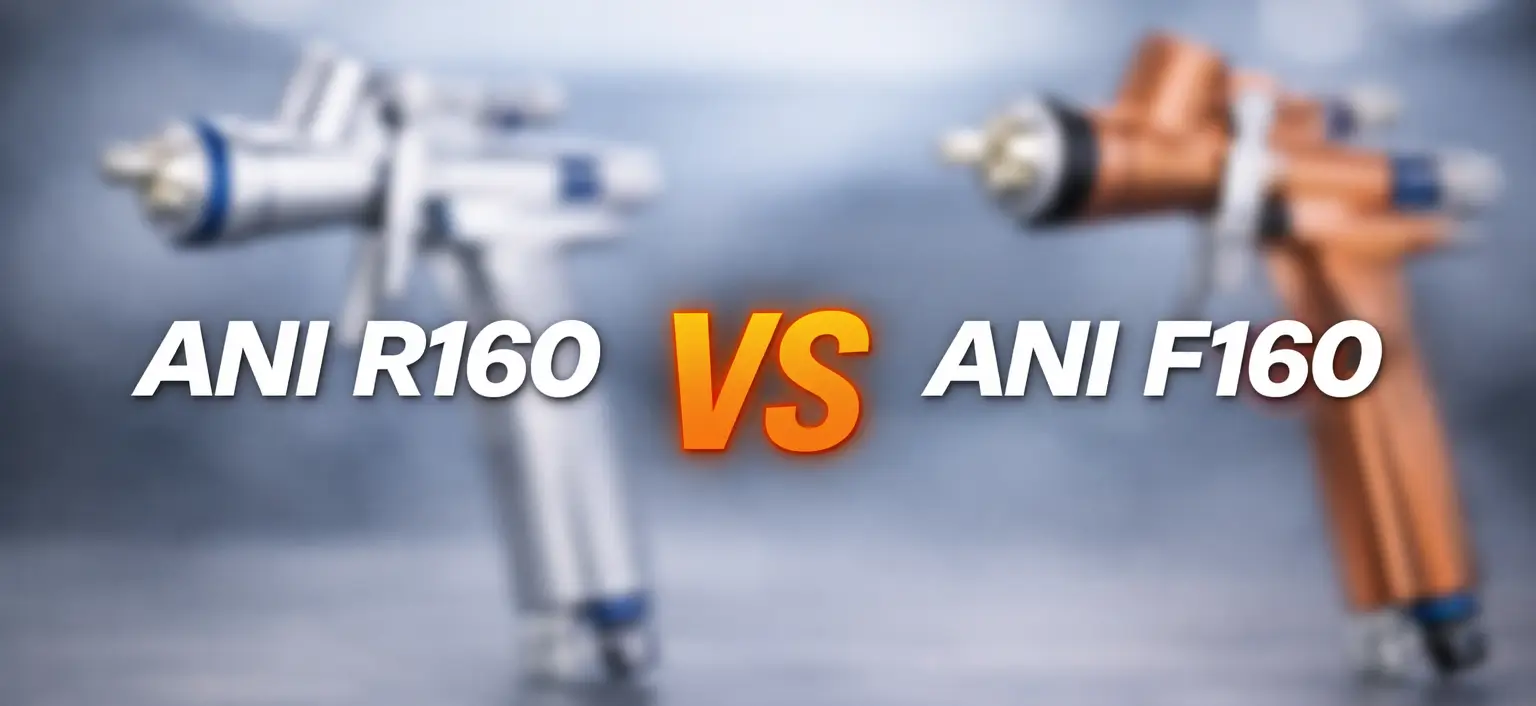
Key Takeaways
- The ANI R160 is the better choice for clearcoat and final finishing, delivering finer atomization and a smoother surface with less polishing required.
- The ANI F160 is more versatile and forgiving, making it a stronger option for basecoat and general-purpose use across different materials.
If you’re comparing ANI R160 vs ANI F160, the real decision is not about which is better overall, but which fits your workflow. The R160 prioritizes finish quality and control, while the F160 focuses on ease of use and flexibility. Choosing the wrong one usually leads to either unnecessary polishing work or inconsistent results across materials.
ANI R160 vs ANI F160
Both spray guns belong to ANI’s professional lineup and share similar build quality, ergonomics, and HVLP efficiency. The difference lies in how they are tuned. The R160 is built for controlled, fine atomization suited to finishing work, while the F160 is designed to handle a wider range of coatings with less sensitivity to setup and technique.
ANI R160 – Quick Overview
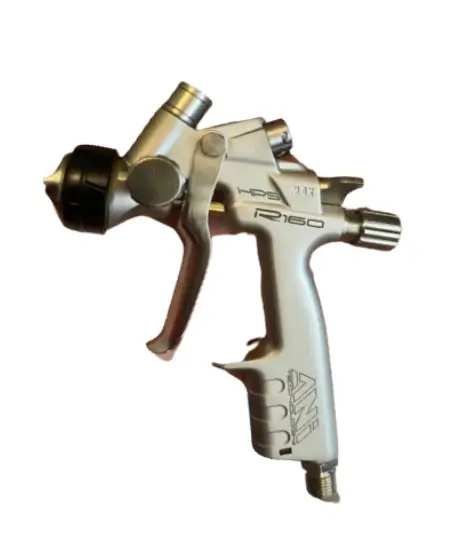
The ANI R160 is a high-efficiency spray gun designed with a clear focus on finishing performance.
It emphasizes fine atomization and tight control, which allows for smoother clearcoat application and better surface leveling. This reduces the need for correction work after spraying, which is where it stands out in real-world use.
It is best suited for painters who already have a consistent technique and want to push finish quality further.
Available in multiple nozzle sizes, including 1.2, 1.3, and 1.4 mm variants.
ANI F160 – Quick Overview
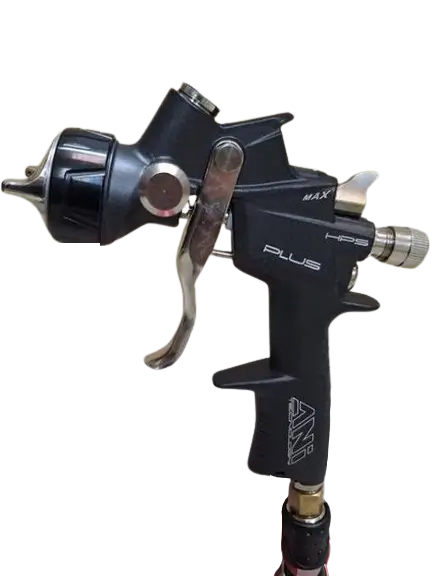
The ANI F160 is built as a flexible, everyday spray gun that can handle multiple stages of the painting process.
It delivers a stable and predictable spray pattern that is easier to control, even with a less precise setup. This makes it particularly useful for basecoat and general-purpose work where consistency matters more than maximum refinement.
It is often chosen by users who want one reliable gun rather than multiple specialized ones.
Available in multiple nozzle sizes, including 1.3, 1.4, 1.5, and 1.7 mm variants.
The ANI F160 is built as a flexible, everyday spray gun that can handle multiple stages of the painting process. It delivers a stable and predictable spray pattern that is easier to control, even with a less precise setup. This makes it particularly useful for basecoat and general-purpose work where consistency matters more than maximum refinement. It is often chosen by users who want one reliable gun rather than multiple specialized ones.
Available in multiple nozzle sizes, including 1.3, 1.4, 1.5, and 1.7 mm variants.
ANI R160 vs ANI F160 – Comparison
Factor | ANI R160 | ANI F160 |
Primary Use | Clearcoat/finishing | Basecoat / general use |
Atomization Quality | Very fine | Good |
Transfer Efficiency | High | High |
Spray Pattern Stability | Excellent | Very good |
Ease of Use | Moderate | Easy |
Material Versatility | Medium | High |
Overspray Control | Excellent | Good |
Speed of Application | Moderate | Faster |
Finish Quality | Superior | Good |
Air Consumption | Moderate | Moderate |
Forgiveness (user error) | Low | High |
Ideal User Level | Intermediate to advanced | Beginner to intermediate |
How They Feel in Use
The R160 feels precise and somewhat demanding. It reacts clearly to small adjustments in pressure and distance, which is why experienced users can get excellent results from it. The spray pattern is controlled and consistent, helping achieve a smooth clearcoat with minimal texture. However, this precision comes with a downside. If your setup is off, you will see issues faster, such as dry spray or uneven coverage.
The F160 feels more stable and easier to manage. It does not require the same level of fine-tuning to produce acceptable results. The spray pattern is slightly softer, which helps hide small mistakes during application. This makes it a better choice for longer jobs or mixed-use scenarios where consistency matters more than absolute finish quality.
ANI R160 Technical Details
- Spray technology: HVLP / High efficiency
- Recommended pressure: ~2.0 bar
- Nozzle sizes: 1.2 / 1.3 / 1.4 mm
- Cup capacity: 600 ml
- Air consumption: ~350–380 L/min
- Body: Anodized aluminum
- Needle/nozzle material: Stainless steel
- Fan width: Wide, controlled pattern
- Weight: Lightweight (~450 g)
- Application focus: Clearcoat, finishing layers
ANI F160 Technical Details
- Spray technology: HVLP / High efficiency
- Recommended pressure: ~2.0 bar
- Nozzle sizes: 1.3 / 1.4 / 1.5 / 1.7 mm
- Cup capacity: 600 ml
- Air consumption: ~340–370 L/min
- Body: Anodized aluminum
- Needle/nozzle material: Stainless steel
- Fan width: Wide, slightly softer edges
- Weight: Lightweight (~460 g)
- Application focus: Basecoat, general-purpose use
Choosing Between the Two
If your work focuses on clearcoat and final-finish quality, the R160 is the better tool. It produces a finer spray, which directly translates into a smoother surface and less polishing time. This matters most in professional environments where finish quality is the priority and time spent correcting defects has a real cost.
The F160 is the better choice if you want one gun to handle multiple stages reliably. It works well with basecoat and can still deliver acceptable clearcoat results, especially outside of high-end finishing scenarios. Its main advantage is consistency. You are less likely to run into application issues when conditions are not perfect.
For the sealer, both guns are usable, but the F160 fits better due to its flexibility. When it comes to primer surfacer, neither gun is designed for heavy material. However, the F160 with a larger nozzle size can handle light primer work, while the R160 is not intended for that use.
Final Words
The ANI R160 and ANI F160 serve different roles, and choosing correctly depends on how you work.
The R160 is a finishing-focused tool. It rewards good technique with better results and less correction work.
The F160 is a general-purpose solution. It trades some finish quality for ease of use and a broader application range.
If your goal is to improve final finish quality, the R160 is the logical upgrade. If your goal is to simplify your workflow with one reliable gun, the F160 is the more practical option.
FAQ
Is the ANI R160 a good choice for beginners?
It is not ideal. The R160 requires more precise setup and technique, which can lead to inconsistent results for less experienced users.
Can the ANI F160 handle both basecoat and clearcoat?
Yes, it can handle both. It performs best with basecoat but still delivers acceptable clearcoat results in most situations.
Which spray gun produces a better final finish?
The R160 produces a smoother finish with finer atomization, especially on clearcoat.
Do they require different compressors?
No. Their air consumption is similar, so the same compressor setup can typically support both.
Which one is better for occasional or mixed use?
The F160 is better suited for mixed use because it is more forgiving and works well across different materials.