

Key Takeaways
- DeVilbiss DV1 is better for control, efficiency, and forgiving application, especially for basecoat and users with less consistent technique.
- SATAjet X 5500 is better for speed, consistency, and high-output work where uniform coverage matters more than forgiveness.
If you’re comparing DeVilbiss DV1 vs SATAjet X 5500, you’re deciding between control and production speed. Both are high-end spray guns, but they behave very differently once you start spraying.
The DV1 prioritizes smooth atomization and control over material flow, making it easier to manage mistakes. The X 5500 is built for uniform coverage at speed, but it expects consistent technique and a stable air supply.
The right choice depends more on how you spray than what you spray.
DeVilbiss DV1 vs SATAjet X 5500
This comparison focuses on real-world use, not just specifications. Both guns are used professionally, but they also appeal to advanced DIY users chasing professional-level results.
The main differences show up in atomization behavior, air demand, and how each gun reacts when your technique isn’t perfect.
DeVilbiss DV1 – Quick Overview
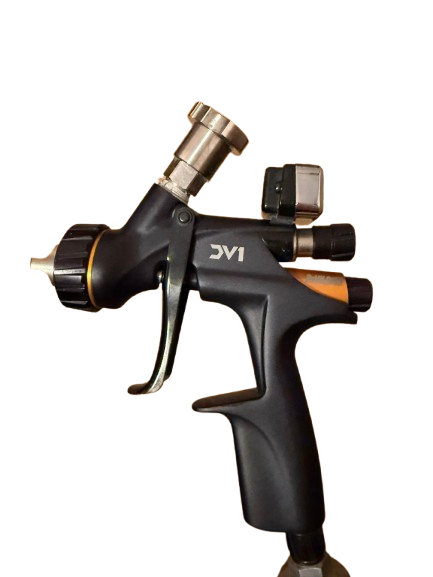
The DeVilbiss DV1 is designed as a refinement-focused spray gun, prioritizing ultra-fine atomization with reduced air turbulence. Compared to traditional designs, it aims to deliver smoother finishes with less overspray and better control over material application.
In practice, it feels balanced and controlled, with a softer spray pattern that gives you more time to adjust your movement. This makes it especially useful for basecoat work, blending, and situations where precision matters.
It stands out for users who don’t spray at full production speed every day, or who want a gun that helps reduce the risk of runs and dry spots.
The DV1 is available in basecoat and clearcoat versions, along with multiple air cap setups, allowing some flexibility depending on material and preference.
SATAjet X 5500 – Quick Overview
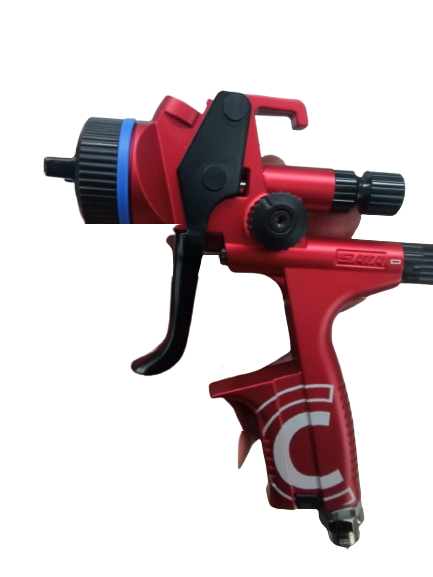
The SATAjet X 5500 is built around consistency and speed. Its redesigned nozzle system focuses on even material distribution across the entire fan, reducing striping and patchiness, especially in fast workflows.
What sets it apart is how stable and predictable the spray pattern remains, even when moving quickly. The fan stays wide and uniform, which allows experienced painters to maintain consistent coverage across large panels.
However, that consistency comes with higher demands. The gun is less forgiving if your speed, distance, or air pressure fluctuates.
The X 5500 is available in HVLP and RP versions, with I and O fan patterns to adjust how the material is distributed.
DeVilbiss DV1 vs SATAjet X 5500 – Comparison
|
Feature |
DeVilbiss DV1 |
SATAjet X 5500 |
|
Atomization quality |
Extremely fine, soft |
Very fine, more aggressive |
|
Air consumption |
Lower |
Higher |
|
Spray pattern feel |
Smooth, forgiving |
Wide, consistent |
|
Fan distribution |
Slightly softer edges |
Very even edge-to-edge |
|
Overspray control |
Better |
Moderate |
|
Speed of application |
Medium |
Fast |
|
Ease of use |
Easier for DIY/advanced users |
Requires more control |
|
Finish consistency |
High, but technique-dependent |
Very high, more uniform |
|
Ideal use |
Basecoat, detail work |
Basecoat & clearcoat production |
|
Efficiency (material use) |
Higher |
Slightly lower |
|
Compressor requirements |
More forgiving |
Demands stronger airflow |
|
Learning curve |
Lower |
Higher |
How they feel in use
The difference becomes clear as soon as you start spraying.
The DV1 feels softer and more controlled. The atomization is fine but not overly aggressive, which gives you a wider margin for error. If your distance or speed isn’t perfectly consistent, the finish is more likely to stay even. This makes it easier to avoid common issues like dry spray or uneven metallic laydown.
The SATAjet X 5500 feels faster and more direct. The fan is wider and more uniform, but also less forgiving. It expects consistent hand speed and distance. When used correctly, it produces very even coats quickly. When used inconsistently, issues like striping or uneven coverage appear faster, especially on metallic basecoats.
In practical terms:
DV1 favors control and correction
X 5500 favors speed and consistency
DeVilbiss DV1 Technical Details
- Spray technology: HVLP / Trans-Tech hybrid design
- Air consumption: ~9–12 CFM (depending on setup)
- Operating pressure: ~1.5–2.0 bar (22–29 PSI)
- Nozzle sizes: 1.1 – 1.4 mm (varies by version)
- Fan size: Medium-wide, soft edges
- Weight: ~470 g
- Material passages: Anodized aluminum (reduced contamination)
- Trigger response: Smooth, progressive
- Best for: Basecoat, blending, controlled clearcoat work
SATAjet X 5500 Technical Details
- Spray technology: HVLP or RP (high pressure)
- Air consumption: ~10–15 CFM
- Operating pressure: ~2.0 bar (29 PSI typical)
- Nozzle sizes: 1.2 – 1.4 mm
- Fan size: Wide, very uniform distribution
- Weight: ~480 g
- Material passages: Stainless steel
- Trigger response: Direct, fast
- Best for: High-speed basecoat and clearcoat application
Choosing Between the Two
If your priority is control, efficiency, and a more forgiving spray experience, the DeVilbiss DV1 is the better choice. It allows you to work at a more controlled pace, correct small mistakes, and still achieve a clean finish. It is also more tolerant of smaller compressors or setups where airflow is not perfectly consistent.
If your focus is speed, consistency, and production-level output, the SATAjet X 5500 stands out. It is designed for painters who already have a stable technique and sufficient air supply. The uniform fan pattern helps maintain consistent coverage, but it requires you to keep speed, distance, and pressure under control at all times.
Final Words
Both spray guns sit at the top of the market, but they reflect different priorities.
The DeVilbiss DV1 focuses on control, efficiency, and adaptability, making it a strong choice for advanced DIY users and professionals who value precision. The SATAjet X 5500 focuses on consistency and speed, making it better suited to production environments where time and uniformity are critical.
There is no universally better option. The right choice depends on how you work and how consistent your setup and technique are.
FAQ
Is the DeVilbiss DV1 better than the SATAjet X 5500?
Not universally. The DV1 is better for control, efficiency, and forgiving application. The X 5500 is better suited for speed and high coverage. The better choice depends on your spraying style and workflow.
Which spray gun is better for beginners or advanced DIY users?
The DV1 is generally easier to use. Its softer spray pattern gives you more margin for error, which is helpful if your technique is still developing. Read more on what makes a spray gun beginner-friendly.
Does the SATAjet X 5500 use more air?
Yes. The X 5500 typically requires more airflow and is more sensitive to pressure drops. A weaker compressor can affect its consistency and overall performance.
Which is better for basecoat and clearcoat?
Both perform well with basecoat. For clearcoat, the X 5500 is often preferred in fast production settings, while the DV1 offers more control for slower, more precise applications.
Is the price difference justified?
It depends on your use case. If you benefit from faster workflows and consistent output, the X 5500 justifies its cost. If you prioritize control and don’t need production speed, the DV1 often delivers better practical value.