
Key Takeaways
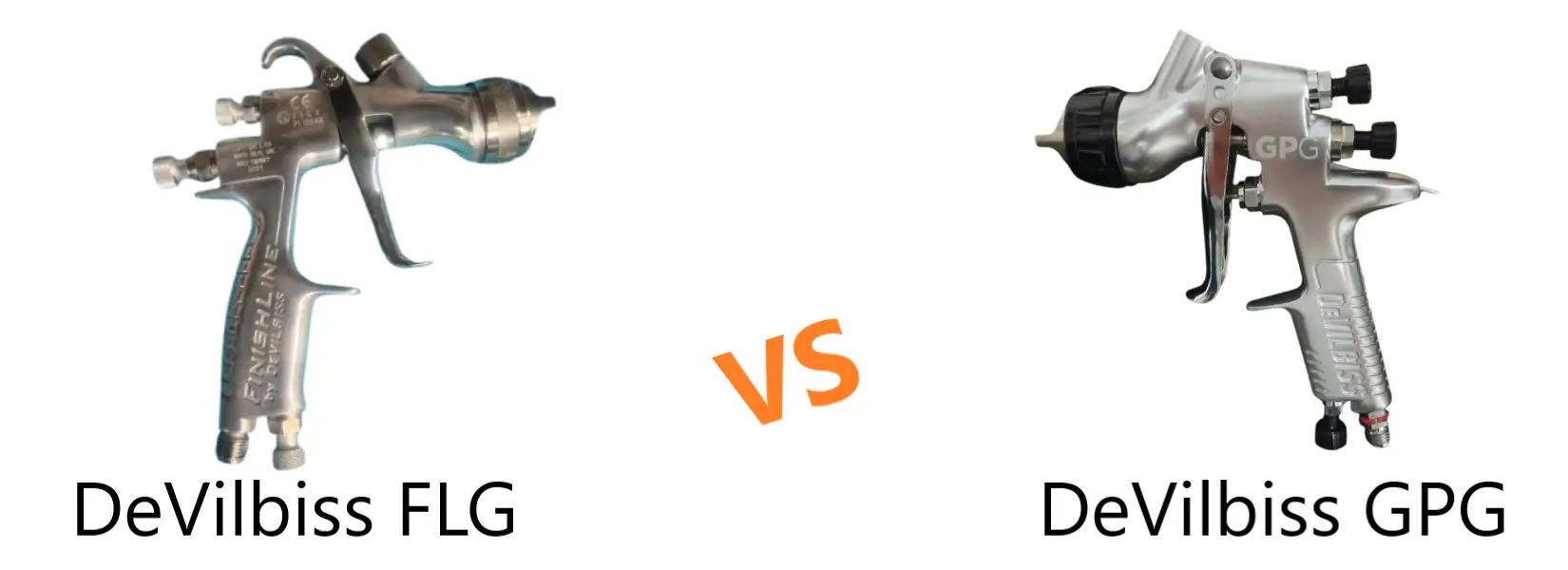
- The DeVilbiss GPG is the better choice for consistent, high-quality finishes, especially for basecoat and clearcoat work where atomization matters most.
- The DeVilbiss FLG is a more forgiving, budget-friendly option that handles primer, sealer, and general-purpose spraying reliably.
If you’re comparing DeVilbiss GPG vs DeVilbiss FLG, you’re likely trying to decide between stepping up to better finish quality or sticking with a versatile, cost-effective tool. The GPG delivers smoother results with less effort, while the FLG trades some refinement for flexibility and ease of use. The right choice depends on whether your priority is finish quality or all-around usability.
DeVilbiss GPG vs DeVilbiss FLG
When comparing the DeVilbiss GPG and FLG, the key difference is how they handle atomization and control during real-world spraying.
The GPG is designed for more refined work, with better droplet breakdown and a more stable fan pattern. The FLG focuses on simplicity and adaptability, making it easier to use across different materials without demanding perfect technique.
DeVilbiss GPG – Quick Overview
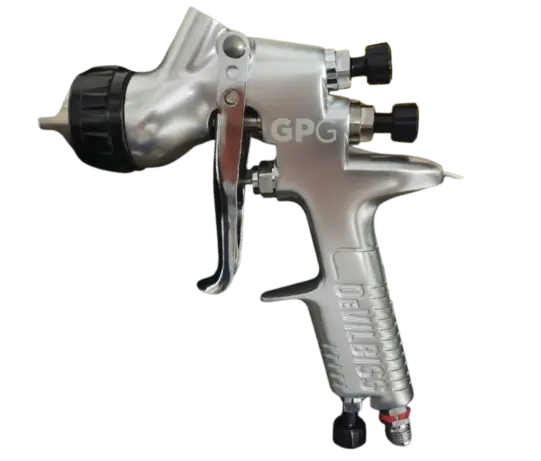
The DeVilbiss GPG is built as a step up from entry-level spray guns, using an improved air cap design to produce finer atomization and more consistent spray patterns. This directly affects finish quality, especially on clearcoat, where uneven atomization leads to texture issues like orange peel.
It is commonly used by painters who want more predictable results without moving into high-end professional guns.
It comes in multiple setups, including different fluid tips and air cap configurations.
DeVilbiss FLG – Quick Overview
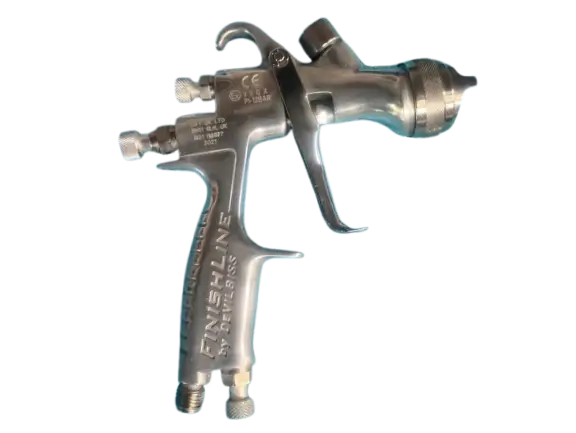
The DeVilbiss FLG is a well-established, budget-conscious spray gun known for reliability and ease of use. It is widely used for primer, sealer, and general refinishing tasks because it handles thicker materials well and does not require a precise setup to perform adequately.
While it can produce good finishes, it relies more on user technique compared to higher-end guns.
It is available in various kits with multiple nozzle sizes and cup configurations.
DeVilbiss GPG vs DeVilbiss FLG – Comparison
|
Feature |
DeVilbiss GPG |
DeVilbiss FLG |
|
Spray Technology |
Trans-Tech / advanced HVLP |
HVLP |
|
Atomization Quality |
Fine and consistent |
Good but coarser |
|
Transfer Efficiency |
Higher |
Moderate |
|
Overspray Control |
Better |
Average |
|
Build Quality |
More refined |
Durable, simpler |
|
Ease of Use |
Requires more control |
Very forgiving |
|
Versatility |
Focused on finishing |
Multi-purpose |
|
Air Consumption |
Moderate (~9–12 CFM) |
Moderate (~10–13 CFM) |
|
Best Use Case |
Basecoat & clearcoat |
Primer, sealer, general use |
|
Price Range |
Mid-range |
Budget to mid-range |
|
Maintenance |
Precise but straightforward |
Very forgiving |
|
Included Kits |
More specialized |
Often bundled kits |
How They Feel in Use
The difference between these two spray guns becomes obvious during actual spraying, not just on paper.
The GPG produces a finer spray pattern that lays material down more evenly. This reduces the risk of dry spots and heavy edges, which are common causes of sanding and rework. When spraying clearcoat, this translates into a smoother finish straight out of the gun, with less polishing required afterward.
The FLG feels more tolerant. It handles thicker materials like primer without struggling, and it doesn’t react as strongly to small setup mistakes. However, when used for basecoat or clearcoat, it tends to produce slightly larger droplets, which can lead to more texture if the technique isn’t dialed in.
In practice, the GPG reduces correction work, while the FLG reduces setup sensitivity.
DeVilbiss GPG Technical Details
- Spray type: Trans-Tech / HVLP hybrid
- Fluid tip sizes: Typically 1.2mm – 1.4mm
- Air consumption: Approx. 9–12 CFM
- Operating pressure: Around 20–29 PSI
- Cup size: ~600 ml gravity cup
- Body material: Anodized aluminum
- Weight: Lightweight and balanced
- Fan pattern: Wide and uniform
- Best coatings: Basecoat, clearcoat
- Transfer efficiency: High
DeVilbiss FLG Technical Details
- Spray type: HVLP
- Fluid tip sizes: Typically 1.3mm – 1.8mm
- Air consumption: Approx. 10–13 CFM
- Operating pressure: Around 23–30 PSI
- Cup size: ~600 ml gravity cup
- Body material: Aluminum
- Weight: Slightly heavier feel
- Fan pattern: Good but less even
- Best coatings: Primer, sealer, general use
- Transfer efficiency: Moderate
Choosing Between the Two
If your priority is achieving a clean, consistent finish with minimal correction, the GPG is the stronger option. It performs better with basecoat and clearcoat because of its finer atomization, which helps avoid common issues like orange peel and uneven metallic distribution. This makes it a better fit for panel work, full resprays, and any situation where appearance is critical.
The FLG makes more sense if you need a versatile tool that can handle different materials without constant adjustment. It is especially useful for primer surfacers and sealers, where material thickness is higher and finish precision is less critical. It is also a safer choice for beginners because it is more forgiving when setup or technique is not perfect.
If you are trying to cover all tasks with one spray gun on a limited budget, the FLG is the more practical choice. If you are separating tasks and want a dedicated gun for finishing work, the GPG is the better long-term investment.
Final Words
The DeVilbiss GPG and FLG serve different roles, even though they overlap in capability.
The GPG focuses on finish quality and consistency. It helps reduce common problems that lead to extra sanding and polishing, making it a better fit for users who care about final appearance.
The FLG focuses on usability and flexibility. It is easier to work with across different materials and is less demanding overall, but it has limitations when it comes to achieving the smoothest possible finish.
The right choice depends on whether you value refinement or versatility more.
FAQ
Is DeVilbiss GPG worth it over FLG for occasional use?
If you only spray occasionally, the FLG is usually enough. The GPG becomes worth it when finish quality starts to matter more than convenience.
Can you spray clearcoat with DeVilbiss FLG?
Yes, but it requires more careful setup and technique to achieve a smooth finish compared to the GPG.
Which spray gun is better for beginners?
The FLG is better for beginners because it is more forgiving and easier to control.
Do both guns require the same compressor?
They are similar in air demand, but both require a compressor that can consistently supply around 10–12 CFM for stable performance.
Should you use one gun for everything or separate them?
Using separate guns is ideal. Many users pair an FLG for primer and a GPG for basecoat and clearcoat to get better results overall.