
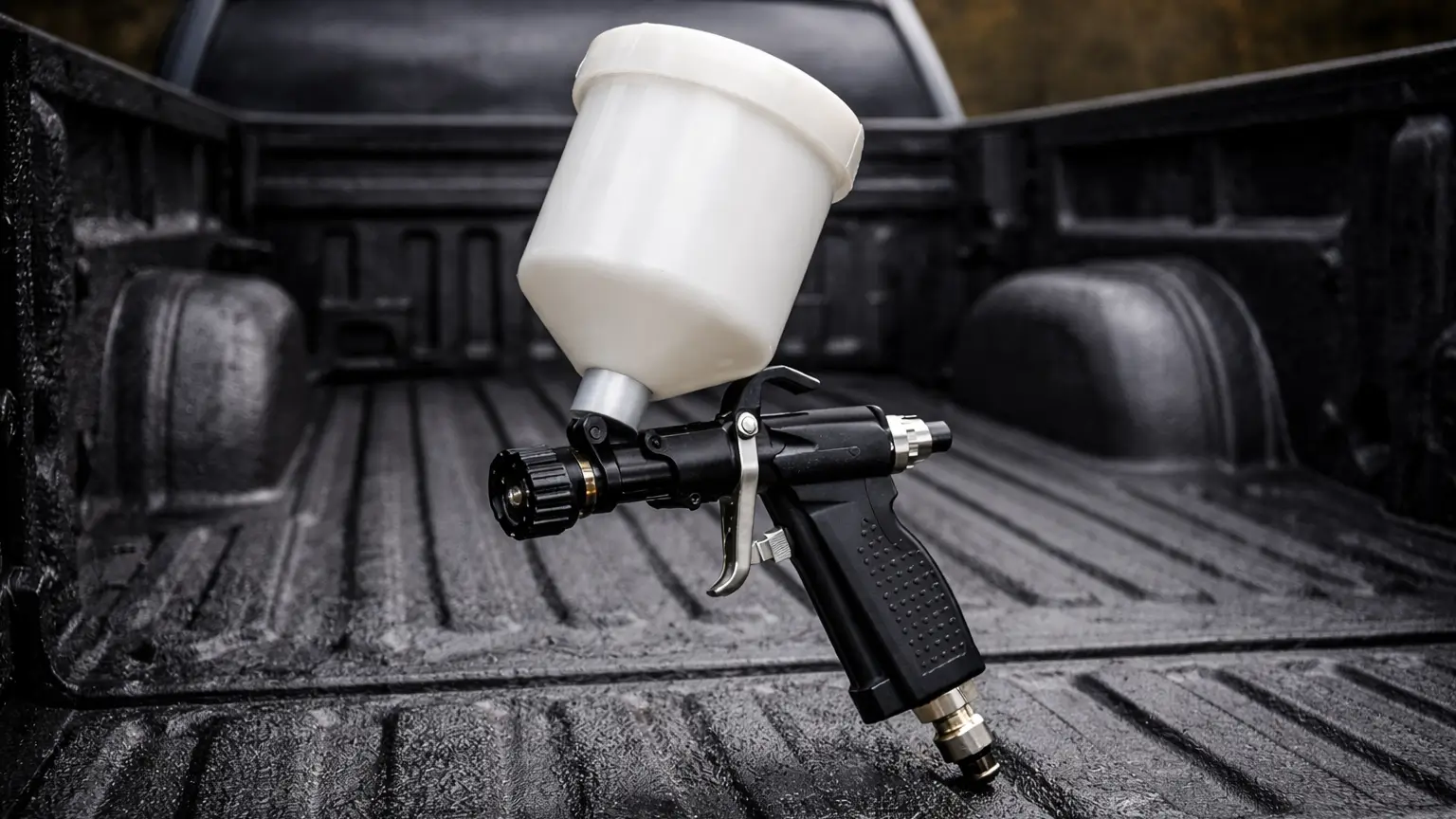
Key Takeaways
- The best bed liner spray gun depends on material thickness, compressor output, and the amount of texture control you need.
- Schutz guns are the most reliable for most users because they handle thick coatings and inconsistent airflow without clogging.
- HVLP guns provide more control over finish but require correct setup and can fail with heavy liners.
- Airless sprayers work for large areas but reduce texture control and can apply too much material too quickly.
Types of Bed Liner Spray Guns
Schutz Spray Guns
Schutz guns are built specifically for thick coatings like bedliner. Their internal design uses larger passages and simpler airflow, which allows them to push heavy material without clogging easily. This makes them highly tolerant of pressure fluctuations, which is important when using smaller compressors that cannot maintain a perfectly stable output.
The trade-off is limited control. The spray pattern is narrow and not fully adjustable, so consistency depends on technique. On large flat surfaces, overlapping passes can create visible variation in texture. However, for truck beds and utility applications, this variation is usually acceptable and does not affect durability.
These guns are the most reliable choice when the priority is getting a durable coating applied without interruption or setup complexity.
Recommended Schutz Guns:
- TCP Global Professional Undercoating Gun
- U-POL Raptor Schutz Spray Gun
- Neiko 31216A Air Spray Gun
HVLP Spray Guns
HVLP spray guns atomize material more finely, which allows better control over how the coating is distributed. This results in a more uniform finish, especially on visible surfaces where texture consistency matters. They also allow adjustment of fan width and material flow, which gives more flexibility than Schutz guns.
The limitation is that the bedliner is much thicker than standard paint. If the nozzle size is too small or the airflow is insufficient, the gun will struggle to atomize the material. This leads to clogging, sputtering, or uneven coverage. Even when it works, achieving consistent results requires careful adjustment of pressure and flow.
HVLP guns are best suited for users who understand how to tune their setup and want more control over the final appearance rather than just durability.
Recommended HVLP Guns:
- DeVilbiss FinishLine 4 FLG-670
- Astro Pneumatic Tool 4008 Spray Gun
- Fuji Spray 2203G Semi-PRO 2
Airless Spray Guns
Airless sprayers use high hydraulic pressure instead of compressed air to push material through a spray tip. This allows them to handle thick coatings without clogging and maintain a constant output regardless of compressor limitations.
The main drawback is a lack of texture control. Because the material is not atomized in the same way, the finish tends to be more uniform and less textured. This can reduce grip and change the appearance compared to traditional bedliner finishes. They also apply more material per pass, which increases the risk of uneven buildup on smaller surfaces.
Airless sprayers are best used when covering large areas quickly. For smaller or detail-focused applications, they are harder to control and can lead to over-application.
Recommended Airless Spray Guns:
- Graco Magnum X5 Airless Paint Sprayer
- Wagner Control Pro 130 Power Tank
- Titan ControlMax 1700 Pro
Best Bed Liner Spray Guns
U-POL Raptor Schutz Spray Gun
This spray gun is designed specifically for bedliner and works reliably with thick material straight from the bottle. Its internal design allows material to flow without requiring precise pressure control, which makes it resistant to clogging and interruptions during spraying.
Best for: Beginners and standard truck bed applications
Key Specs:
- Bottle-fed system
- Large nozzle opening
- Low sensitivity to pressure variation
- Compatible with standard compressors
|
Pros |
Cons |
|
Maintains spray even with unstable airflow |
Limited control over spray width |
|
Rarely clogs with thick material |
Texture consistency depends on technique |
|
Minimal setup required |
Not suited for large flat panels |
Verdict:
A dependable option that reduces the most common beginner failures, especially clogging and uneven spray caused by poor airflow.
TCP Global Professional Undercoating Gun
This model improves consistency by using a more durable body and a slightly more responsive output adjustment. It performs better during longer sessions, where cheaper guns tend to clog or lose spray consistency.
Best for: Repeat use and consistent results
Key Specs:
- Heavy-duty aluminum construction
- Adjustable output
- Stable material flow
- Standard compressor compatibility
|
Pros |
Cons |
|
More stable spray during extended use |
Still limited fan control |
|
Less prone to partial clogging |
Slightly heavier |
|
Durable for multiple projects |
Requires minor adjustment |
Verdict:
A practical step up that improves reliability without introducing complexity or setup sensitivity.
Neiko 31216A Air Spray Gun
This entry-level gun works for light use but shows limitations when handling thicker materials or longer sessions. It is more sensitive to pressure drops and can clog more easily than higher-quality models.
Best for: Occasional use and small projects
Key Specs:
- Lightweight body
- Basic nozzle design
- Bottle-fed system
- Standard air connection
|
Pros |
Cons |
|
Low upfront cost |
Higher risk of clogging |
|
Simple operation |
Inconsistent spray with pressure drops |
|
Easy to handle |
Limited durability |
Verdict:
Suitable for small jobs, but performance limitations become clear with thicker coatings or extended use.
DeVilbiss FinishLine 4 FLG-670
This HVLP gun offers precise control over spray pattern and material distribution. When set up correctly with an appropriate nozzle size and pressure, it produces a more uniform finish than Schutz guns.
Best for: Controlled and even finishes
Key Specs:
- HVLP system
- Multiple nozzle sizes
- Adjustable fan pattern
- High transfer efficiency
|
Pros |
Cons |
|
Precise control over spray pattern |
Requires correct setup |
|
Even coverage across surfaces |
Can clog with a thick liner |
|
Durable construction |
Needs a stable air supply |
Verdict:
Best for users who prioritize finish consistency and are willing to manage setup variables.
Astro Pneumatic Tool 4008 Spray Gun
This gun provides more flexibility than basic models by allowing adjustment of the spray pattern and flow. It performs well when properly configured, but is less forgiving than Schutz guns.
Best for: Intermediate users seeking more control
Key Specs:
- HVLP design
- Adjustable fan width
- Lightweight construction
- Moderate air demand
|
Pros |
Cons |
|
Greater control over coverage |
Sensitive to setup errors |
|
Versatile across coatings |
May require material adjustment |
|
Good performance for cost |
Not ideal for very thick liners |
Verdict:
A transition option that offers more control but requires attention to setup and material behavior.
Graco Magnum X5 Airless Paint Sprayer
This airless sprayer delivers continuous high-pressure output, allowing fast coverage without relying on compressed air. It handles thick coatings easily and maintains consistent flow over large areas.
Best for: Large surface coverage and speed
Key Specs:
- Airless high-pressure system
- Adjustable pressure
- Continuous feed
- No compressor required
|
Pros |
Cons |
|
Fast coverage |
Limited texture control |
|
Handles thick material easily |
Risk of over-application |
|
Consistent output | Less precise in small areas |
Verdict:
Effective for large-scale work where speed matters, but less suitable for detailed or texture-focused applications.
Buying Guide
Air Compressor Compatibility
One of the most overlooked factors is whether your compressor can actually support the spray gun. Many users buy a gun without checking airflow requirements, leading to weak spray patterns or inconsistent texture. Shultz guns typically require less air, making them more compatible with home setups. HVLP guns and pressure systems demand higher CFM, and underpowered compressors will cause sputtering or uneven coverage.
Texture Control vs Simplicity
Not all spray guns offer the same level of control. Schutz guns prioritize ease of use but sacrifice precision, producing a more fixed and aggressive texture. HVLP guns allow finer adjustment of spray pattern and material distribution, but require consistent airflow and proper setup to avoid uneven results.
Airless sprayers deliver uniform coverage quickly, but reduce the ability to control texture, often resulting in a flatter finish. According to Marvel Coatings, which offers one of the toughest spray-on bedliners, achieving consistent texture depends more on controlled application and matching the spray method to the material than on the gun itself. This is why an improper setup often leads to disappointing results even with high-end equipment.
Material Thickness Handling
Bedliner materials vary widely in thickness. Some guns struggle with thicker coatings, leading to clogging or uneven spraying. Entry-level guns may require thinning, which can affect durability. Higher-end systems handle thicker materials better, maintaining consistent flow without compromising the finish.
Durability and Cleaning
Bedliner material is harsh on equipment. Cheap guns may work for one project but fail afterward due to clogging or wear. Cleaning is also more difficult than standard paint. Guns with simpler internal designs are easier to maintain, while complex systems require more effort but last longer if properly cared for.
3M Performance vs 3M Accuspray Spray Guns
UV vs IR Lighting for Auto Painting
Common Mistakes
Choosing the Wrong Gun Type
Many users buy HVLP guns expecting better results, but without proper setup, they perform worse than basic Schutz guns. Understanding your skill level and equipment is critical before committing to a spray gun for applying spray-on bed liner.
Ignoring Compressor Requirements
Using an underpowered compressor leads to inconsistent spray and poor texture. Always match the gun’s air requirements to your compressor’s output. Calculate how much airflow you need with the air compressor size calculator.
Not Adjusting for Material Thickness
Different liners require different settings. Failing to adjust pressure or nozzle size often results in clogging or uneven coating.
Poor Cleaning Practices
Bedliner material hardens quickly. Skipping proper cleaning after use can permanently damage the gun, especially cheaper models.
Final Words
The best bed liner spray gun isn’t about picking the most expensive option—it’s about matching the tool to your experience level, compressor, and project size. For most users, a quality Schutz gun delivers excellent results with minimal hassle. More advanced systems only make sense when you truly need the extra control or efficiency.
FAQ
What is the best spray gun for bedliner for beginners?
A Schutz-style gun like the U-POL Raptor is the easiest to use and requires minimal setup.
Can you use an HVLP gun for bedliner?
Yes, but only if the material is properly adjusted. HVLP guns offer better control but require more experience.
Do you need a special spray gun for a bedliner?
Not strictly, but standard paint guns struggle with thick coatings. Bedliner-specific guns perform better.
What size compressor do I need for a bedliner spray gun?
Most Schutz guns work with small compressors, while HVLP requires higher airflow.
Why does my bedliner spray unevenly?
Common causes include incorrect pressure, clogged nozzles, or using a gun that can’t handle the material thickness.