
Key Takeaways
If you’re choosing between a horizontal vs vertical air compressor for garage or DIY use, here’s the short answer:
- Choose a vertical air compressor if you’re short on floor space, want a fixed setup, and plan to use it regularly
- Choose a horizontal air compressor if you need portability, flexibility, and only use it occasionally
The difference is not about power. It’s about how the compressor fits into your space and how often you want to move it.
What You’re Actually Comparing
The core difference between a horizontal and vertical air compressor is not performance. It’s layout.
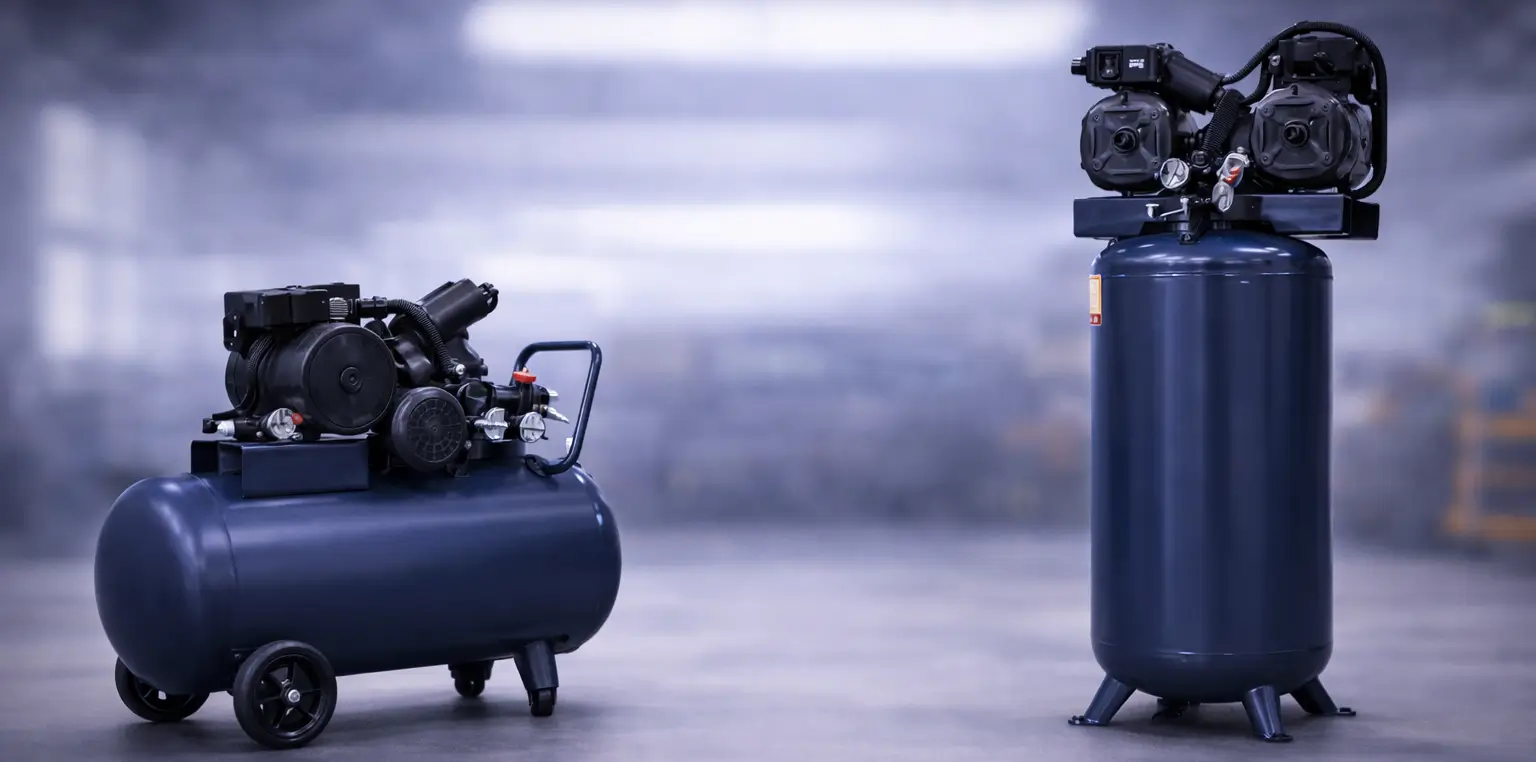
A horizontal air compressor spreads across the floor. It’s lower, wider, and usually mounted on wheels. You move it to where you need it.
A vertical air compressor stacks the tank upward. It takes up less floor space and is typically placed in a fixed location.
This comparison exists because most home garages are limited in space, not power. Both types can deliver similar PSI and airflow in the same price range. What changes is how they behave in your workflow.
This is a trade-off between mobility and footprint, not capability.
The Differences Between Horizontal and Vertical Air Compressors
Space and Footprint
This is the most immediate and often the most important difference.
A vertical air compressor uses significantly less floor space. You can place it in a corner and keep your working area open. In smaller garages, this quickly becomes a long-term advantage.
A horizontal unit takes up more usable space. Even if it seems compact at first, it competes with tools, storage, and movement paths.
Over time, this becomes noticeable. A horizontal compressor often ends up being something you move out of the way before starting work.
Portability and Movement
Horizontal compressors are designed to move.
Most come with wheels and a handle. You can roll them across the garage, outside the house, or reposition them depending on the task.
Vertical compressors are not built for that kind of use. Even if they have wheels, they are heavier, taller, and less stable while moving. In practice, they stay in one place.
This changes how you use the tool. A portable compressor gets used casually. A fixed compressor becomes part of your setup.
Stability and Feel in Use
Vertical compressors feel more planted during operation.
They are upright, often heavier, and less prone to shifting. This creates a more stable experience, especially during longer runs.
Horizontal compressors can vibrate more, particularly on uneven floors. It’s not a safety issue, but you will notice more movement in lighter models.
This affects confidence over time. A vertical unit feels like a permanent tool. A horizontal one feels temporary, even if you use it often.
Noise
Noise levels depend mostly on the motor and pump, not orientation. But how that noise is experienced can differ.
Horizontal compressors sit closer to the ground, and sound reflects off the floor and nearby surfaces. In tight garages, this can feel sharper.
Vertical compressors project sound upward. In cluttered or partially insulated spaces, this can make the noise feel less concentrated.
The difference is subtle, but noticeable in smaller garages.
Maintenance and Access
Horizontal compressors are easier to work on.
Everything is at a lower height. Draining the tank, checking fittings, and adjusting components is straightforward.
Vertical compressors can be slightly less convenient depending on placement. Controls may be higher, and the tank drain can be harder to access if it’s tucked into a corner.
This matters over time. If maintenance feels inconvenient, it tends to get delayed. That affects lifespan more than most beginners expect.
Performance Under Load
This is where confusion often happens.
Orientation does not affect performance. A vertical air compressor is not inherently more powerful than a horizontal one.
What matters is:
- Tank size
- Pump design
- Motor quality
However, vertical compressors are often designed with larger tanks for the same floor space. This makes them feel more capable during longer tasks like spraying or running air tools continuously.
The performance difference comes from capacity, not shape.
Cost Over Time
Initial pricing is usually similar for comparable specifications.
Vertical compressors often provide more tank capacity without taking more floor space. That can make them feel like better value in smaller garages.
Horizontal compressors are commonly available in smaller, lower-cost models. These are appealing for occasional use.
Long-term cost depends on how well the compressor matches your usage. A poorly matched compressor leads to inefficiency, frustration, and eventually replacement.
Simple Comparison Table
|
Factor |
Vertical Air Compressor |
Horizontal Air Compressor |
|
Space usage |
Minimal floor space |
Takes up more floor space |
|
Portability |
Limited |
Easy to move |
|
Stability |
Very stable |
Slight movement possible |
|
Accessibility |
Slightly less convenient |
Easier access |
|
Typical use |
Fixed workshop setup |
Flexible, mobile use |
|
Tank capacity (per footprint) |
Higher |
Lower |
Real-World Behavior Over Time
With a vertical air compressor, your workflow becomes stable.
You stop moving the compressor. You run hoses instead. It becomes part of your environment, not something you manage. Over time, this reduces friction. You turn it on and work.
With a horizontal compressor, the flexibility stays useful, but it comes with a small recurring effort. You move it, position it, and store it again.
At first, this feels convenient. Over time, it can become a minor barrier. The more steps required to start using a tool, the less often it gets used spontaneously.
The difference shows up in consistency. Vertical setups support routine use. Horizontal setups support flexible use.
Common Mistakes
The most common issue is a mismatch between expectations and actual use.
- A horizontal compressor in a tight garage often becomes an obstacle. You end up moving it before and after every task. This adds friction and interrupts workflow.
- A vertical compressor bought for portability leads to the opposite problem. It’s difficult to move, so it stays in place even when you need it elsewhere.
- Another common mistake is assuming vertical means higher performance. Buyers choose a vertical unit expecting more power, but get similar output in a different form.
- There is also a maintenance issue. If access is slightly inconvenient, users delay draining the tank. Over time, this increases moisture buildup and shortens lifespan.
These problems are not about the compressor itself. They come from choosing the wrong format for the way you actually work.
Myths and Misconceptions
A common belief is that vertical air compressors are more powerful. That’s not the case. Power comes from the pump and motor, not the tank orientation.
Another misconception is that horizontal compressors are only for beginners. In reality, they are widely used in mobile and job-site environments because of their portability.
Some assume vertical compressors are harder to maintain. In practice, the difference is minor if the unit is placed correctly and accessible.
The confusion comes from how these compressors are marketed, not how they perform.
What People Wish They Knew Before Buying
Users with vertical compressors often mention how clean and organized their workspace feels. The compressor stays out of the way and is always ready.
Users with horizontal compressors highlight flexibility. They can move the unit wherever the work is happening, inside or outside.
Over time, the complaints follow predictable patterns.
People using vertical air compressors sometimes wish they could move the unit more easily, while users of horizontal units often get tired of repositioning the compressor, especially in smaller spaces.
The preference depends on whether you value a fixed setup or adaptable movement.
Choose Based On Your Use
For occasional use, such as inflating tires or light cleaning, a horizontal compressor fits naturally. You take it out, use it, and store it without committing space.
For regular DIY work, a vertical compressor becomes more practical. It removes setup steps and keeps your workspace consistent.
For heavier or longer tasks, vertical units often feel more stable and integrated into the workflow. The larger tank capacity commonly found in these models supports continuous use better.
In light professional scenarios, the decision depends on mobility. If you move between locations, horizontal makes more sense. If you work from a fixed garage, vertical is more efficient.
Making the Decision
- Choose a vertical air compressor if your space is limited, you work regularly in one place, and you want a permanent setup
- Choose a horizontal air compressor if you need mobility, work in different areas, and prefer flexibility over fixed efficiency
Final Thoughts
The decision between a vertical or a horizontal air compressor comes down to how you work, not what the specifications say.
Vertical compressors reduce friction in a fixed workspace. They save space and stay ready.
Horizontal compressors give you flexibility. They move with your work but require more handling.
If you choose based on your actual habits instead of assumptions, the compressor becomes easy to live with. If you don’t, it becomes something you constantly adjust around.
Frequently Asked Questions
Is a vertical air compressor better than a horizontal one?
No. A vertical air compressor is not inherently better. It simply uses space more efficiently. The better choice depends on whether you prioritize a fixed setup or portability.
Do vertical air compressors have more power?
No. Power comes from the motor and pump, not the tank orientation. Vertical models may feel more capable because they often have larger tanks, but that’s a design choice, not a rule.
Which air compressor is better for a small garage?
A vertical air compressor is usually the better fit for small garages because it takes up less floor space and can be placed in a corner without interfering with movement.
Are horizontal air compressors easier to move?
Yes. Horizontal compressors are designed for mobility. Most come with wheels and handles, making them easier to move around the garage or outside.
Is maintenance different between vertical and horizontal compressors?
The maintenance itself is the same, but access can differ. Horizontal compressors are generally easier to reach, which can make routine tasks like draining the tank more convenient.
Which type lasts longer?
Lifespan depends on build quality, maintenance, and usage, not orientation. A well-maintained compressor of either type can last many years.
Can you use a vertical air compressor for portable jobs?
You can, but it’s not ideal. Vertical compressors are heavier and less stable to move, so they are better suited for staying in one place rather than being transported frequently.